
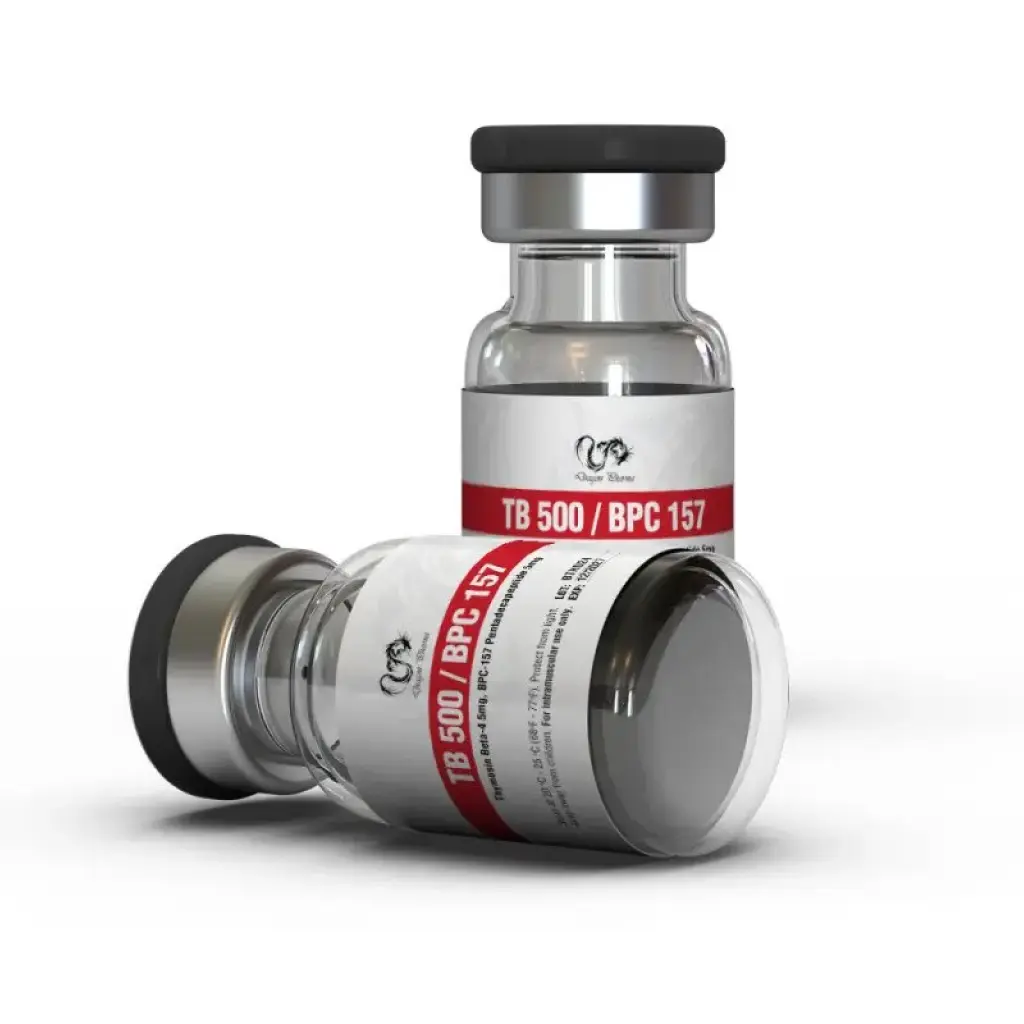
Dragon Pharma TB 500 5 mg/BPC 157 5 mg supplies a lyophilized formulation combining two of the most discussed tissue-repair research peptides in a single vial. BPC-157 (Body Protection Compound-157) is a synthetic pentadecapeptide derived from human gastric juice, studied primarily for angiogenic and extracellular matrix remodeling activity. TB-500 is a synthetic fragment of Thymosin Beta-4, studied for cell migration, actin polymerization, and inflammatory modulation.
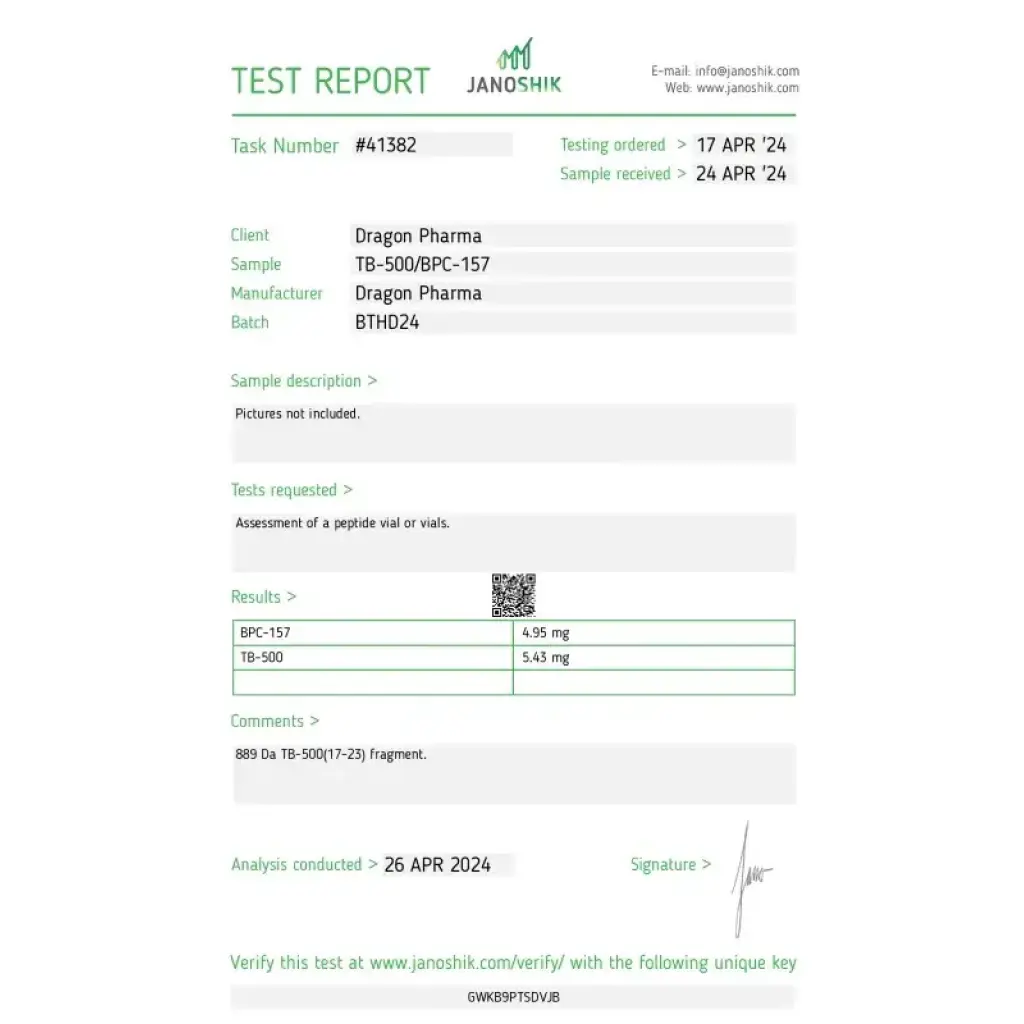
This Dragon Pharma formulation provides 10 mg total peptide content per 2 mL vial (5 mg TB-500 + 5 mg BPC-157) in lyophilized powder form, requiring reconstitution before laboratory use. One third-party lab report is supplied for batch BTHD24 (April 2024), documenting 5.43 mg TB-500 and 4.95 mg BPC-157. The combination is commonly marketed as the "Wolverine Stack," but the rationale for stacking is mechanistic hypothesis—not demonstrated clinical synergy.
BPC-157 has been investigated extensively in rodent models of tendon, ligament, muscle, and bone injury. Proposed mechanisms include VEGFR2-mediated angiogenesis, eNOS activation, and integrin modulation, with downstream effects on collagen organization and fibroblast migration. A 2025 systematic review found consistent improvements in animal healing models but classified the overall evidence at the lowest clinical research levels and described human safety data as unknown.
TB-500's research situation is more complicated. The peptide is a fragment of Thymosin Beta-4, a naturally occurring actin-binding protein. While TB-4 has been studied in ophthalmic, dermatologic, and cardiovascular contexts, direct musculoskeletal evidence for the TB-500 fragment remains limited to in vitro and rodent studies. A 2026 scoping review found no human randomized trial supporting TB-500 injection for musculoskeletal injury. The "stacking" rationale—combining angiogenic and cell-migration mechanisms—has not been tested in any controlled study.
Researchers comparing this blend to single-peptide products should note that the combination has not been studied as a unit. BPC 157 5 mg is available as a standalone product for protocols isolating its effects. TB 500 5 mg is available separately for TB-500-specific research. The combination product is intended for researchers who specifically want both peptides in a single reconstitution step; it does not imply that combining them produces superior outcomes.
This product is a lyophilized research peptide blend supplied for laboratory investigation only. It is not intended for human or veterinary consumption.
Labeled product attributes and general research reference data for the TB 500/BPC 157 blend.
| Product Name | TB 500 5 mg/BPC 157 5 mg |
|---|---|
| Active Ingredients | TB-500 (Thymosin Beta-4 fragment) 5 mg + BPC-157 5 mg per vial |
| Peptide Class | TB-500: actin-binding repair fragment; BPC-157: gastric-derived repair peptide |
| Labeled Strength | 10 mg total per vial (5 mg + 5 mg) |
| Dosage Form | Lyophilized powder |
| Package Contents | 2 mL vial containing 10 mg total peptide |
| Manufacturer | Dragon Pharma |
| Administration Route | Not established; research use only |
| Lab Verification | One COA supplied (batch BTHD24): TB-500 5.43 mg, BPC-157 4.95 mg |
| BPC-157 Proposed Mechanism | Angiogenesis (VEGFR2/eNOS), collagen remodeling, integrin modulation |
|---|---|
| TB-500 Proposed Mechanism | Actin polymerization, cell migration, inflammatory modulation |
| Stacking Rationale | Hypothesis: complementary angiogenic + migratory pathways produce additive repair effects. Not tested. |
| BPC-157 Human Evidence | One small retrospective case series; no controlled trials |
| TB-500 Human Evidence | No human musculoskeletal trials; most data is full-length TB-4, not the fragment |
| Regulatory Status | Neither peptide FDA-approved for human use |
Supporting research resources for the pharmacological information above.
Research values are general reference information. This product is supplied for laboratory research only.
This blend is supplied as lyophilized powder for laboratory research. No approved human dosing regimen exists for either peptide, individually or in combination.
Lyophilized TB-500/BPC-157 blend requires reconstitution with a suitable solvent before laboratory use. Bacteriostatic Water is commonly used for peptide reconstitution. For a 10 mg vial (5 mg + 5 mg), adding 2 mL of solvent yields a concentration of 2.5 mg/mL for each peptide. Gentle swirling—not vigorous shaking—is recommended to avoid peptide aggregation.
No pharmacokinetic data exists for this specific combination in any species. BPC-157 is natively found in gastric juice and can be administered orally in research settings, though bioavailability is lower than injection. TB-500 is typically studied via subcutaneous or intramuscular injection. The combination has not been evaluated for safety or efficacy in controlled settings.
This peptide blend has no established human dosing, safety profile, or therapeutic indication. All information above pertains to laboratory handling only. Neither BPC-157 nor TB-500 has completed controlled human trials for musculoskeletal indications, and the combination has not been studied as a unit. This product is supplied strictly for laboratory research.
One laboratory report is supplied for Dragon Pharma TB 500 5 mg/BPC 157 5 mg, documenting measured content for batch BTHD24.

Lab results reflect the specific batch tested. A test of one batch does not guarantee the quality, purity, or sterility of every batch.
Shipping estimates and fulfillment options vary by warehouse and product availability. Review the information below before placing your order.
Orders dispatched from our international warehouse typically arrive within 13–15 business days after dispatch. Delivery times may vary depending on destination, customs processing, and carrier conditions.
Eligible orders dispatched from our U.S. domestic warehouse typically arrive within 4–5 business days after dispatch. This option is available only for products stocked in the domestic warehouse.
Review the complete shipping terms, delivery conditions, and applicable order policies before placing an order.
Lyophilized peptides require specific storage conditions to maintain stability. Follow the guidance below for Dragon Pharma TB 500 5 mg/BPC 157 5 mg.
Store lyophilized powder refrigerated at 2°C to 8°C or frozen at -20°C for long-term storage. Avoid repeated temperature fluctuations.
Keep the vial sealed and protected from humidity. Lyophilized peptides are hygroscopic; moisture exposure can degrade the peptides before reconstitution.
Store in the original packaging or a dark container. Protect from direct light, which can degrade peptide structure.
Keep the lyophilized powder in the supplied vial until reconstitution. Allow refrigerated vials to reach room temperature before opening to prevent condensation.
Common questions about the TB 500/BPC 157 blend, its research background, and laboratory handling.
No human safety data exists to answer this definitively. Preclinical studies have not reported hepatotoxicity as a primary signal, and BPC-157 is derived from a gastric protein. However, the 2025 systematic review described human safety data as "unknown", and ECRI/ISMP warn that gray-market peptides may contain contaminants that could affect the liver. This product is for laboratory research only.
The combination is studied—primarily in animals—for tissue repair applications including tendon, ligament, muscle, and bone healing. BPC-157 is proposed to act through angiogenesis and collagen remodeling; TB-500 through cell migration and actin polymerization. The "Wolverine Stack" combination is based on the hypothesis that these mechanisms are complementary, but no controlled study has tested the stack itself.
No evidence suggests BPC-157 affects testosterone. It is not a hormone, steroid, or androgen receptor modulator. Its proposed mechanisms involve local tissue repair pathways (angiogenesis, collagen synthesis), not the hypothalamic-pituitary-gonadal axis. No study has reported testosterone suppression or elevation with BPC-157 in any species.
No human data establishes an onset timeline. In animal models, BPC-157 effects on tendon healing have been observed at 14 days and beyond, but animal timelines do not translate to humans. TB-500 has even less data. The one small retrospective human case series for BPC-157 did not provide a validated onset timeframe. Any claims about "how fast" these peptides work in humans are anecdotal.
Batch BTHD24 (April 2024) measured 5.43 mg TB-500 (108.6% of the 5 mg label claim) and 4.95 mg BPC-157 (99.0% of the 5 mg label claim). This is one batch only. ECRI/ISMP testing of gray-market peptides found purity ranging from 5% to 75% across samples, with heavy metal contamination in some. A single COA does not guarantee other batches.
No. TB-500 is a synthetic seven-amino-acid fragment of the full Thymosin Beta-4 protein. Most published research examines full-length TB-4, not the TB-500 fragment, so evidence for one does not automatically apply to the other. This distinction is frequently blurred in marketing materials.
Store the lyophilized powder refrigerated (2–8°C) or frozen (-20°C), protected from light and moisture. Allow vials to reach room temperature before opening to prevent condensation. After reconstitution, refrigerate and use according to your laboratory protocol. Avoid repeated freeze-thaw cycles. No manufacturer-verified stability data was supplied for this specific blend.
No. Neither peptide has FDA approval for any human use. The FDA has not identified adequate safety information for their proposed routes of administration. An FDA advisory panel voted in 2026 to recommend adding both to the 503A compounding list, but this is not the same as FDA approval and does not constitute a finding of safety or efficacy.
Have you tried this product? Share your experience to help other customers. Log in to write a review.