
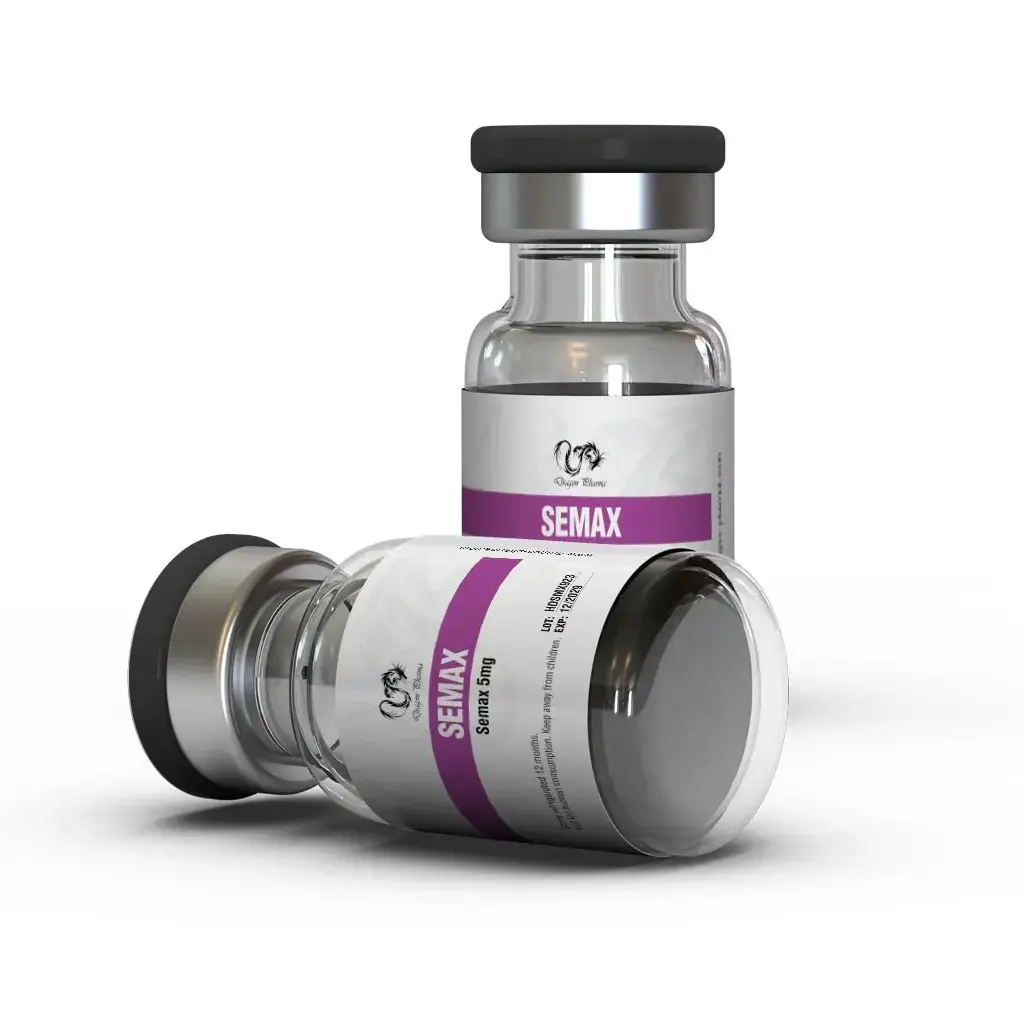
Dragon Pharma Semax 5 mg supplies a lyophilized formulation of Semax, a synthetic seven-amino-acid peptide (Met-Glu-His-Phe-Pro-Gly-Pro) derived from the ACTH(4-10) fragment of adrenocorticotropic hormone, with a C-terminal Pro-Gly-Pro sequence added for stability. Developed in Russia, Semax is approved there for stroke and cognitive/neurological conditions, but it is **not FDA-approved** in the United States.
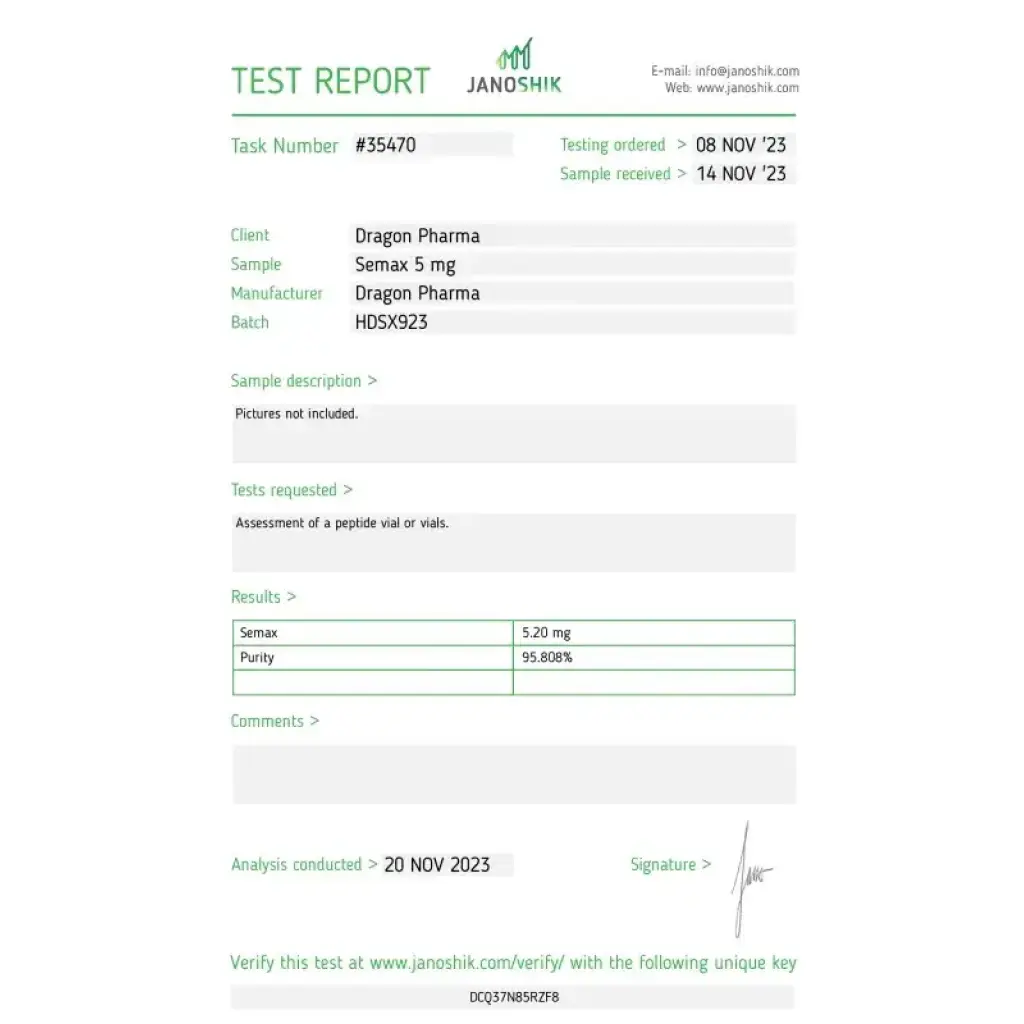
This Dragon Pharma formulation provides 5 mg of Semax per 2 mL vial in lyophilized powder form, requiring reconstitution before laboratory use. One third-party lab report is supplied for batch HDSX923 (November 2023), documenting 5.2 mg measured content (104% of label). Semax is studied primarily for neuroprotective and nootropic mechanisms—BDNF elevation, modulation of dopaminergic and serotonergic systems, and gene expression changes in ischemic brain injury models.
Semax is proposed to act through multiple pathways: increasing neurotrophic factors like BDNF and NGF, modulating dopaminergic and serotonergic neurotransmission, and influencing gene expression in response to ischemic injury. In rat models of transient middle cerebral artery occlusion, Semax administration modulated the expression of nearly two thousand genes in the frontal cortex, many associated with neuroactive ligand-receptor interactions and inflammatory responses.
The clinical evidence base is geographically concentrated and methodologically limited. Russian studies have reported benefits in stroke rehabilitation and cognitive disorders, but these trials are described as small, often developer-affiliated, and lacking independent replication. The FDA's review for 503A compounding concluded that "there is insufficient clinical information to characterize the safety profile of Semax" and that no human pharmacokinetic studies were identified for any route of administration.
Semax and Selank 10 mg are both synthetic seven-amino-acid peptides developed in Russia, but they are based on different natural molecules and have different proposed mechanisms. Semax derives from ACTH and is studied for neuroprotection and cognition; Selank derives from tuftsin and is studied for anxiolytic effects through GABA and serotonin systems. Neither is FDA-approved, and the human evidence for both is similarly limited.
This product is a lyophilized research peptide supplied for laboratory investigation only. It is not intended for human or veterinary consumption.
Labeled product attributes and general research reference data for Semax 5 mg.
| Product Name | Semax 5 mg |
|---|---|
| Active Ingredient | Semax (Met-Glu-His-Phe-Pro-Gly-Pro; ACTH(4-10) analog) |
| Peptide Class | Synthetic regulatory peptide; nootropic/neuroprotective |
| Labeled Strength | 5 mg per vial |
| Dosage Form | Lyophilized powder |
| Package Contents | 2 mL vial containing 5 mg Semax |
| Manufacturer | Dragon Pharma |
| Administration Route | Not established; research use only (clinical literature discusses intranasal) |
| Lab Verification | One COA supplied; measured 5.2 mg per vial (see Lab Results) |
| Primary Research Focus | Neuroprotection, cognitive function, BDNF/NGF modulation |
|---|---|
| Amino Acid Sequence | Met-Glu-His-Phe-Pro-Gly-Pro |
| Proposed Mechanisms | BDNF/trkB upregulation; dopaminergic/serotonergic modulation; gene expression regulation in ischemia |
| Human Pharmacokinetics | No human PK studies identified by FDA for any route |
| Russian Approval | Approved for stroke and cognitive/neurological conditions |
| US Regulatory Status | Not FDA-approved; 503A advisory vote favorable but non-binding (July 2026) |
| FDA Safety Concerns | Insufficient safety data; potential immunogenicity with injectables; possible bleeding risk |
Supporting research resources for the pharmacological information above.
Research values are general reference information. This product is supplied for laboratory research only.
Semax is supplied as lyophilized powder for laboratory research. No FDA-approved dosing regimen exists; clinical literature discusses intranasal administration in Russian studies.
Lyophilized Semax requires reconstitution with a suitable solvent before laboratory use. Bacteriostatic Water is commonly used for peptide reconstitution. For a 5 mg vial, adding 2 mL of solvent yields a concentration of 2.5 mg/mL. Gentle swirling—not vigorous shaking—is recommended to avoid peptide aggregation. The FDA specifically noted concerns about aggregation and immunogenicity with injectable Semax formulations.
Russian clinical studies have used intranasal Semax, with doses of 6000 mcg/day for 10 days in stroke rehabilitation. These are specific clinical protocols, not recommendations for research vials. The FDA could not identify human pharmacokinetic studies for Semax by any route, so absorption, distribution, and clearance are not well characterized.
Semax has no FDA-approved dosing regimen. The FDA has stated that there is insufficient clinical information to characterize its safety profile, no human pharmacokinetic studies were identified, and concerns exist regarding immunogenicity with injectable forms and possible bleeding risk. This product is supplied strictly for laboratory research.
One laboratory report is supplied for Dragon Pharma Semax 5 mg, documenting measured content for batch HDSX923.

Lab results reflect the specific batch tested. A test of one batch does not guarantee the quality, purity, or sterility of every batch. The FDA has noted concerns about Semax peptide characterization, impurities, and aggregation potential.
Shipping estimates and fulfillment options vary by warehouse and product availability. Review the information below before placing your order.
Orders dispatched from our international warehouse typically arrive within 13–15 business days after dispatch. Delivery times may vary depending on destination, customs processing, and carrier conditions.
Eligible orders dispatched from our U.S. domestic warehouse typically arrive within 4–5 business days after dispatch. This option is available only for products stocked in the domestic warehouse.
Review the complete shipping terms, delivery conditions, and applicable order policies before placing an order.
Lyophilized peptides require specific storage conditions to maintain stability. Follow the guidance below for Dragon Pharma Semax 5 mg.
Store lyophilized powder frozen at -20°C or below for long-term storage. The FDA notes Semax is expected to be stable under reported storage conditions below -20°C.
Keep the vial sealed and protected from humidity. Lyophilized peptides are hygroscopic; moisture exposure can degrade the peptide before reconstitution.
Store in the original packaging or a dark container. Protect from direct light, which can degrade peptide structure.
Keep the lyophilized powder in the supplied vial until reconstitution. Allow frozen vials to reach room temperature before opening to prevent condensation.
Common questions about Semax 5 mg, its research background, and laboratory handling.
Semax is proposed to act as a nootropic and neuroprotectant by increasing BDNF and NGF, modulating dopamine and serotonin systems, and influencing gene expression in ischemic brain injury. Russian studies report cognitive and stroke rehabilitation benefits, but the human evidence is limited to small, methodologically weak trials that have not been independently replicated to Western standards. It is not FDA-approved.
According to Russian labeling, Semax is contraindicated in pregnancy, breastfeeding, acute psychotic states, anxiety disorders, history of seizures, and endocrine disease/thyroid dysfunction. The FDA also noted possible antithrombotic properties that raise concern about bleeding risk, particularly in populations at risk for bleeding or those taking anticoagulant medications. This product is for research use only.
Semax has been proposed as a potential ADHD treatment in Russian literature, based on its effects on dopamine and BDNF systems. However, no large-scale, placebo-controlled trials have established efficacy for ADHD, and no peptide is FDA-approved for ADHD. A 2026 Russian expert council classified Semax as "Group B, with a limited evidence base" for ADHD adjunctive use.
There is no established daily regimen for research vials. Russian clinical protocols for stroke used 6000 mcg/day intranasally for 10 days. Community discussions of nootropic use describe intermittent or on/off patterns to manage tolerance, but these are anecdotal conventions, not validated schedules. The FDA identified no human pharmacokinetic data to inform any dosing frequency.
One COA is supplied. The November 2023 test of batch HDSX923 measured 5.2 mg per vial, which is 104% of the labeled 5 mg. Lab results reflect the specific batch tested and do not guarantee other batches. The FDA noted concerns about Semax characterization and impurities in its 503A review.
No. Semax is approved in Russia for stroke and cognitive/neurological conditions, but not by the FDA. In July 2026, an FDA advisory committee gave a non-binding favorable vote toward 503A compounding eligibility, but FDA staff opposed it citing insufficient evidence, and the vote does not constitute approval.
Store the lyophilized powder frozen at -20°C or below, protected from light and moisture. Allow vials to reach room temperature before opening to prevent condensation. After reconstitution, refrigerate and use according to your laboratory protocol. Avoid repeated freeze-thaw cycles. The FDA notes Semax is expected to be stable under reported storage conditions below -20°C.
Both are synthetic seven-amino-acid peptides developed in Russia, but based on different natural molecules. Semax derives from ACTH and is studied for neuroprotection and cognition; Selank 10 mg derives from tuftsin and is studied for anxiolytic effects through GABA and serotonin systems. Neither is FDA-approved, and the human evidence for both is limited to small, mostly Russian studies.
Have you tried this product? Share your experience to help other customers. Log in to write a review.