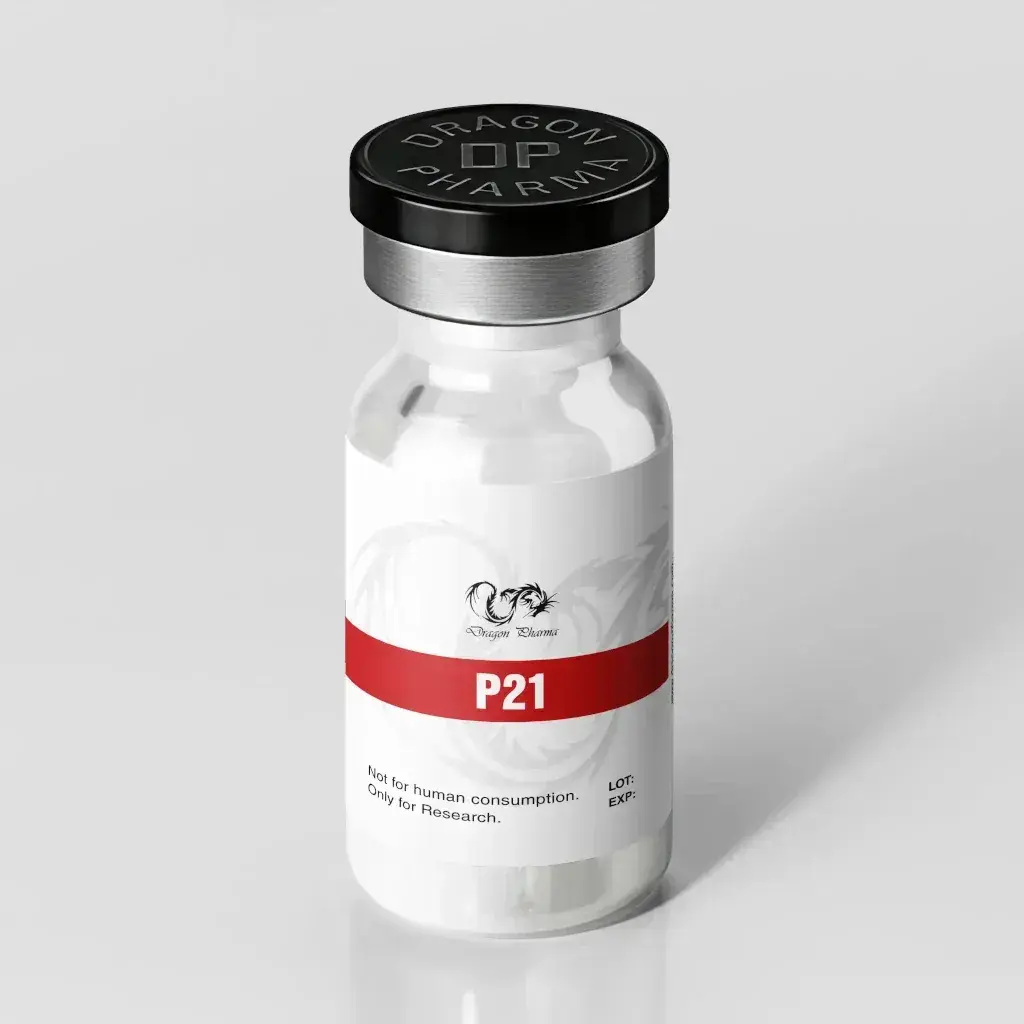
Dragon Pharma P21 5 mg supplies a lyophilized formulation of P21, also designated P021 in scientific literature—a synthetic pentapeptide derived from the active region of ciliary neurotrophic factor (CNTF). Unlike growth hormone secretagogues or repair peptides, P021 is studied primarily for its effects on neurotrophic signaling, adult hippocampal neurogenesis, and tau pathology in rodent models of aging and Alzheimer's disease.
This Dragon Pharma formulation provides 5 mg of P21 per 2 mL vial in lyophilized powder form, requiring reconstitution before laboratory use. The peptide has a lipophilically modified structure (adamantylated glycine at the C-terminus) designed to improve stability and oral bioavailability in research settings. Critically, no human clinical trials of P021 exist—the entire efficacy record is preclinical, largely from a single laboratory, and at least one independent model showed no benefit.
Key Research Characteristics
CNTF-Derived Mechanism: P021 is a pentapeptide mimetic of CNTF, designed to activate neurotrophic signaling without the immunogenicity of the full protein.
Preclinical Cognitive Data: Rodent studies report improved maze learning, increased BDNF, and reduced tau hyperphosphorylation in aging and Alzheimer's models.
Single-Lab Evidence: Almost all published research originates from one laboratory; independent replication is limited.
Negative Model Exists: In Cdkl5 knockout mice, chronic P021 failed to raise BDNF and did not improve neuroanatomical defects.
No Human Data: Zero registered or published human trials as of 2026; no human dose, pharmacokinetics, or safety data exists.
Naming Ambiguity: "P21" may also refer to the cell-cycle protein p21/CDKN1A—a completely unrelated molecule. Verify sequence on any product label.
How P021 Is Studied
P021 is described as a CNTF-derived pentapeptide with a C-terminal adamantylated glycine modification intended to enhance stability and lipophilicity. In rodent models, chronic administration has been reported to increase adult hippocampal neurogenesis, elevate BDNF levels, and reduce GSK-3β-driven tau hyperphosphorylation—mechanisms associated with improved learning and memory. A 12-month dietary dosing study in an Alzheimer's mouse model reported no weight loss, tumors, or overt toxicity, and unlike native CNTF, P021 did not induce anti-CNTF antibodies.
However, the translation gap is substantial. A study in Cdkl5 knockout mice—a model outside the originating laboratory—found that chronic P021 treatment failed to increase BDNF levels and did not improve neuroanatomical defects, yielding only limited behavioral benefit. This negative result underscores the uncertainty around whether the rodent signal is robust or model-specific. No human pharmacokinetic data exists to inform any dosing strategy.
P21 vs. Other Neurotrophic Research Peptides
P021's research focus on neurotrophic signaling distinguishes it from peptides like Semax 5 mg, which is studied for neurotrophic and cognitive effects through different mechanisms, and from Humanin 10 mg, a mitochondrial-derived peptide studied for cytoprotection. Researchers interested in neurotrophic pathways may also evaluate DIHEXA 5 mg, though its mechanism differs fundamentally. None of these compounds has approved human indications, and no controlled study has tested them in combination.
Important Considerations
This product is a lyophilized research peptide supplied for laboratory investigation only. It is not intended for human or veterinary consumption. P021 has no human safety data, no established dosing, and no approved indications. Theoretical concerns include possible immunogenicity (anti-P021 antibodies) and unintended proliferative effects from upregulating neurotrophic signaling, though no tumor signal appeared in long-term rodent dosing. The naming ambiguity with p21/CDKN1A means buyers should verify the exact peptide sequence before ordering.
Formulation & Research Profile
Product Specifications
Labeled product attributes and general research reference data for P21 5 mg (P021).
Research values are general reference information. This product is supplied for laboratory research only. No human clinical trial of P021 exists.
Laboratory Handling Context
Research Handling Information
P21 is supplied as lyophilized powder for laboratory research. No approved human dosing regimen exists. The information below addresses reconstitution and handling for research applications only.
Reconstitution Overview
Lyophilized P21 requires reconstitution with a suitable solvent before laboratory use. Bacteriostatic Water is commonly used for peptide reconstitution. For a 5 mg vial, adding 2 mL of solvent yields a concentration of 2.5 mg/mL. Gentle swirling—not vigorous shaking—is recommended to avoid peptide degradation.
In rodent research, P021 was administered orally via diet or gavage in most studies, leveraging its lipophilic modification for oral bioavailability. The pharmacokinetics of subcutaneous or other routes in humans are entirely unknown—no human data exists for any route. Reconstituted peptide should be stored refrigerated and used within the timeframe specified by the laboratory protocol.
Practical Handling Considerations
Reconstitution volume: 2 mL solvent yields 2.5 mg/mL; adjust volume to achieve the desired working concentration.
Solvent selection: Bacteriostatic water is standard for most peptide research.
Handling technique: Swirl gently; avoid vortexing or vigorous shaking.
Storage after reconstitution: Refrigerate reconstituted peptide; stability data for this specific product is not available.
Research route context: Rodent studies used oral dosing; human injection or nasal delivery is completely uncharacterized.
Related neurotrophic peptides:Semax 5 mg is studied for neurotrophic effects through ACTH-derived mechanisms; Humanin 10 mg is a mitochondrial-derived cytoprotective peptide.
Important Research Notice
P021 has no established human dosing, safety profile, or therapeutic indication. All information above pertains to laboratory handling only. No human trial has tested P021, and the one independent animal model that measured BDNF found no increase. This product is supplied strictly for laboratory research and is not intended for human administration.
Delivery & Fulfillment
Shipping & Delivery Information
Shipping estimates and fulfillment options vary by warehouse and product availability. Review the information below before placing your order.
Shipping Options & Delivery Estimates
International Warehouse
International Fulfillment
13–15Business Days
Orders dispatched from our international warehouse typically arrive within 13–15 business days after dispatch. Delivery times may vary depending on destination, customs processing, and carrier conditions.
U.S. Domestic Warehouse
Domestic Fulfillment
4–5Business Days
Eligible orders dispatched from our U.S. domestic warehouse typically arrive within 4–5 business days after dispatch. This option is available only for products stocked in the domestic warehouse.
Important Shipping Information
Warehouse availability: Not all products are available from both warehouses. Available shipping options are displayed on the product page.
Order processing: Delivery estimates begin when an order is dispatched, not when payment is completed. Processing time before dispatch is additional.
Shipment tracking: Tracking information is provided when available, according to the applicable shipping policy.
Delivery delays: Customs inspections, carrier disruptions, holidays, and other circumstances may affect estimated delivery times.
Full Shipping Policy
Review the complete shipping terms, delivery conditions, and applicable order policies before placing an order.
Lyophilized peptides require specific storage conditions to maintain stability. Follow the guidance below for Dragon Pharma P21 5 mg.
Recommended Storage Conditions
Storage Temperature
Store lyophilized powder refrigerated at 2°C to 8°C or frozen at -20°C for long-term storage. Avoid repeated temperature fluctuations.
Moisture Protection
Keep the vial sealed and protected from humidity. Lyophilized peptides are hygroscopic; moisture exposure can degrade the peptide before reconstitution.
Light Exposure
Store in the original packaging or a dark container. Protect from direct light, which can degrade peptide structure.
Original Vial
Keep the lyophilized powder in the supplied vial until reconstitution. Allow refrigerated vials to reach room temperature before opening to prevent condensation.
Handling & Stability
Expiration date: Refer to the date printed on the vial, if present. No manufacturer-verified shelf life was supplied for this batch.
Shelf life (lyophilized): Generally stable for extended periods when refrigerated or frozen and protected from moisture; follow any manufacturer-printed date.
After reconstitution: Refrigerate and use within the timeframe specified by your laboratory protocol. No stability data for this specific product was supplied.
Handling technique: Use sterile technique when reconstituting. Avoid repeated freeze-thaw cycles of reconstituted solution.
Child safety: Store in a locked refrigerator or cabinet inaccessible to children and pets.
Disposal: Dispose of unused peptide according to institutional or local laboratory waste guidelines.
Product Questions & Answers
Frequently Asked Questions
Common questions about P21 5 mg, its research background, and laboratory handling.
01
What are the benefits of the P21 peptide in research?
Preclinical rodent studies report that P021 increases adult hippocampal neurogenesis, elevates BDNF, reduces tau hyperphosphorylation, and improves maze learning in aging and Alzheimer's models. However, no human trials exist, almost all data comes from one laboratory, and an independent Cdkl5 knockout model showed no BDNF increase and limited behavioral benefit. Any cognitive benefit in humans is unvalidated extrapolation.
02
What peptide is P21 exactly?
This listing's "P21" most likely refers to P021, a CNTF-derived pentapeptide with a C-terminal adamantylated glycine, studied for neurotrophic effects. However, "P21" is dangerously ambiguous: it also denotes p21/CDKN1A, a completely unrelated human cell-cycle regulatory protein. Buyers should verify the exact sequence, molecular mass, and lot documentation before ordering.
03
Is P21 safe?
No human safety data exists—zero trials, no human dose, no pharmacokinetics, no safety record. In a 12-month rodent dietary study, no tumors, weight loss, or anti-CNTF antibodies were reported. Theoretical concerns include possible immunogenicity and unintended proliferative effects from neurotrophic upregulation, though no tumor signal appeared in animals. Animal tolerability does not establish human safety.
04
What does P21 do in the body?
In rodents, P021 is reported to cross into the brain and stimulate neurotrophic signaling—increasing BDNF, promoting adult hippocampal neurogenesis, and reducing GSK-3β-driven tau phosphorylation. These mechanisms are associated with improved learning and memory in animal models. In humans, nothing is known: no pharmacokinetic data exists to confirm whether the peptide reaches the brain, what dose would be needed, or whether the rodent effects translate at all.
05
Has P021 been tested in human clinical trials?
No. ClinicalTrials.gov queries and published literature searches as of 2026 return zero human studies of P021. Despite being reported as a lead candidate for Alzheimer's and neurodegenerative diseases by Phanes Biotech, the program remains early-stage with no registered human trials. All efficacy claims are extrapolations from rodent data.
06
How should I store lyophilized P21?
Store the lyophilized powder refrigerated (2–8°C) or frozen (-20°C), protected from light and moisture. Allow vials to reach room temperature before opening to prevent condensation. After reconstitution, refrigerate and use according to your laboratory protocol. Avoid repeated freeze-thaw cycles. No manufacturer-verified stability data was supplied for this specific batch.
07
Is P21 FDA-approved?
No. P021 has no FDA approval for any indication and is not listed among FDA-recognized bulk drug substances eligible for pharmacy compounding. It is sold strictly as a research chemical. Under the FDA's 2025 research-grade-peptide guidance enforceable from January 2026, peptides marketed with dosing instructions or shipped to individuals may be presumed intended for human use regardless of "research use only" labeling.
08
Why is P21 sometimes confused with a different peptide?
The string "P21" is used for at least two unrelated things: P021, the CNTF-derived research peptide, and p21/CDKN1A, a human cell-cycle protein involved in senescence and cancer. A product labeled only "P21" does not establish which molecule it contains. Additionally, the name "Tetrapeptide-21" refers to a completely different cosmetic peptide used in skincare. Always verify sequence and CAS number.
No reviews yet.
Have you tried this product? Share your experience to help other customers. Log in to write a review.