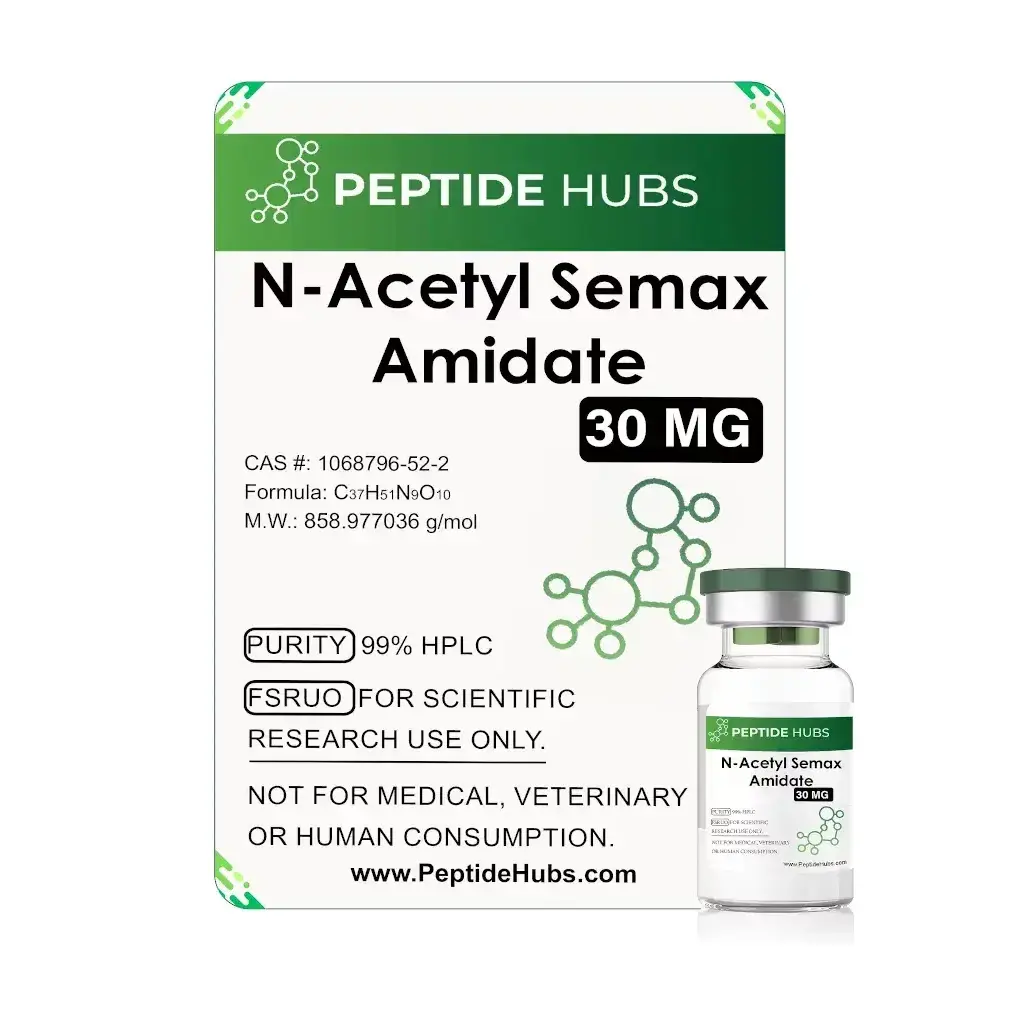
N-Acetyl Semax Amidate 30 mg – Peptide Hubs (2 mL Vial)
Peptide Hubs N-Acetyl Semax Amidate 30 mg is a lyophilized research preparation presented in a sterile 2 mL vial for qualified laboratory use. This acetylated, amidated Semax analog is discussed in experimental literature for CNS-adjacent study designs in which investigators track attention, task consistency, perceived recovery, or other protocol-defined proxies. The 30 mg fill provides ample headroom for multi-arm pilots, replication runs, and extended timelines while keeping the same lot across sessions—ideal for USA labs that prize reproducibility, inventory control, and audit-ready documentation.
Important: All content below is for educational discussion within lawful research contexts. This product is not a drug, food, or cosmetic and is not intended to diagnose, treat, cure, or prevent any disease. Purchase and use assume qualified individuals or laboratories operating under applicable regulations and internal SOPs.
Positioning in the Research Landscape
Neuropeptide analogs are evaluated in test systems for their potential to influence circuit-level dynamics and plasticity-related readouts. When teams plan timing rules and sampling windows, a general primer on synaptic plasticity frameworks can be helpful. For accessible background used to frame endpoints and schedules, see the NCBI/Bookshelf chapter on Neuroplasticity here. While not prescriptive for lab practice, that overview helps set expectations for fixed clocks, measurement cadence, and confounder control—the pillars of interpretable CNS-adjacent data.
Why Choose the 30 mg Strength?
The 30 mg presentation serves method development and longer protocols where minimizing lot changes and reconstitution frequency are priorities. Compared with smaller fills, 30 mg supports:
- Concentrated stock solutions for simple aliquoting and reduced arithmetic error during micro-measurement.
- Parallel arms (e.g., morning vs evening clocks; fed vs fasted; workday vs rest-day) from a single lot, limiting variability.
- Rapid replication of pilots and multi-cohort comparisons without introducing new lots mid-study.
Format, Reconstitution & Storage
- Presentation: Lyophilized N-Acetyl Semax Amidate, 30 mg total in a sterile 2 mL vial.
- Reconstitution: Use sterile technique with bacteriostatic water or another lab-approved solvent. Choose a solvent volume that yields a round-number working concentration (e.g., 3.0 mg/mL) to simplify aliquoting. Pre-plan aliquots to minimize temperature exposure and handling time.
- Storage: Keep lyophilized vials cool, dry, and protected from light per your SOP. After reconstitution, refrigerate promptly and avoid freeze–thaw cycling. Discard if the solution appears cloudy, discolored, or otherwise compromised.
Designing a Clean, Reproducible Protocol
Protocol clarity starts with consistency. Establish a run-in baseline that stabilizes sleep duration/quality, total calories, macronutrient distribution, hydration, stimulant/caffeine intake, and training load. Write administration clocks (relative to meals, work/training sessions, and lights-out) directly into the SOP and memorialize them with an operator checklist for each session.
CNS-adjacent designs benefit from fixed assessment windows—e.g., pre-administration, +30 minutes, +90 minutes, and end-of-day scores—applied identically every test day. If your audience includes bodybuilders or fitness enthusiasts who frequently vary training density, adopt a "no changes" rule on program variables during the intervention window to reduce noise in focus/adherence readouts.
Parallel Arms & Comparison Ideas (Run as Separate Programs)
To preserve interpretability, avoid stacking mechanisms in a single arm. Instead, build parallel arms with identical clocks and measurement cadence so differences map to mechanisms, not confounders:
- Connective-tissue/joint proxies: Keep CNS outcomes separate from connective-tissue models by running Cartalax 20 mg in its own arm while mirroring schedules and logs.
- Immune-adjacent exploration: If your study tracks immune-leaning proxies, profile Thymosin Alpha-1 10 mg separately to prevent systemic effects from blurring CNS readouts.
- Dermal/cosmetic axis: For skin/hair proxies, run a copper-peptide arm with GHK-CU 10 mg, maintaining identical clocks to keep comparisons fair.
- MDP contrast: If you wish to compare CNS-adjacent questionnaires with mitochondria-derived peptides, design an independent program using Humanin 10 mg and preserve the same schedule.
- GHS benchmark (separate arm): For performance-minded cohorts, a ghrelin-receptor secretagogue like Ipamorelin 5 mg can serve as a comparator when body-comp or recovery proxies are of interest—run it independently to avoid mechanism mixing.
Timing, Confounders & Data Integrity
Timing: Set administration-to-meal and administration-to-work/training intervals in minutes and keep them unchanged. If acute sampling is part of the plan, pre-specify exact timepoints and use synchronized timers to prevent drift.
Confounders: Stabilize calories, macro split, hydration, caffeine/stimulant intake, training volume/density, and sleep schedule. For athlete cohorts, log session RPE, workload, and rest so outliers can be contextualized during analysis.
Integrity: Maintain a session checklist: vial ID/lot number, reconstitution date and solvent/volume, final concentration, aliquot size, timestamps, storage temperatures, device calibrations, and operator initials. Document deviations (missed sample, temperature excursion) immediately—these notes make pilot replication and manuscript-ready methods far easier.
Quality, Authenticity & Shipping
Peptide Hubs prioritizes careful sourcing, clear labeling, and protective packaging optimized for USA transit. Our catalog is organized to help researchers design separate, mechanism-specific programs rather than stack endpoints in a single arm—an approach favored by advanced buyers who value clean, reproducible data. For those searching "Buy N-Acetyl Semax Amidate USA" and "Peptide Hubs N-Acetyl Semax Amidate," the 30 mg vial supports concentrated stocks, consistent aliquoting, and efficient multi-arm execution.
Who Chooses N-Acetyl Semax Amidate 30 mg?
Teams running longer timelines or multi-cohort comparisons—especially where lot consistency and fewer reconstitutions are critical—often select the 30 mg size. It offers the bandwidth to examine weekday vs weekend schedules, fed vs fasted windows, and timing contrasts without introducing new lots mid-stream.
Regulatory Notice: Not intended for human consumption. For lawful laboratory research by qualified individuals only.
Frequently Asked Questions
What is N-Acetyl Semax Amidate 30 mg used for in research?
It is examined in experimental systems for CNS-adjacent study designs (e.g., focus/adherence proxies) using fixed timing and standardized handling for clean comparisons.
Why choose the 30 mg vial instead of a smaller fill?
30 mg supports concentrated stocks, fewer reconstitutions, and multi-arm pilots from a single lot—ideal for reproducibility and extended timelines in USA labs.
How should this product be stored and handled?
Keep lyophilized vials cool, dry, and light-protected. Reconstitute with bacteriostatic water using sterile technique, refrigerate after reconstitution, and avoid freeze–thaw cycling per SOP.
Can N-Acetyl Semax Amidate be stacked with other peptides?
For clean data, run different mechanisms in separate arms. For contrast, explore Cartalax 20 mg or GHK-CU 10 mg in parallel programs with mirrored clocks.
Is N-Acetyl Semax Amidate intended for medical treatment?
No. This is a research-grade peptide not intended to diagnose, treat, cure, or prevent any disease. Use is restricted to lawful laboratory research by qualified individuals.
No reviews yet.
Have you tried this product? Share your experience to help other customers. Log in to write a review.